FEOC Requirements for Commercial Solar: What California Businesses Must Know to Claim the 30% Tax Credit
FEOC compliance rules for the 30% solar ITC. Which equipment qualifies, deadlines, and how California businesses can protect their tax credit.
Commercial solar comes with a 30% federal tax credit. But starting in 2026, not every project qualifies.
There’s a regulation called FEOC - Foreign Entity of Concern - that determines whether your solar equipment is eligible for that credit. If you’re a California business owner researching solar, this is probably the first time you’re seeing this term. That’s a problem, because getting it wrong could cost your business six figures.
Here’s what FEOC actually means, how it affects your project, and what you need to do to make sure you qualify.
Key Takeaways
- FEOC rules restrict which solar equipment qualifies for the 30% federal tax credit starting 2026
- Equipment with ties to China, Russia, North Korea, or Iran may disqualify your project
- Projects must meet 40-45% non-FEOC content thresholds to qualify
- The domestic content bonus can boost your credit to 40% with U.S.-made equipment
- Get FEOC compliance documentation in writing before signing any contract
What Is FEOC?
FEOC stands for Foreign Entity of Concern. It’s a federal regulation that restricts which solar equipment qualifies for clean energy tax credits based on where it’s manufactured and who owns the companies making it.
The federal government wants to encourage American businesses to go solar. They don’t want those tax dollars flowing to companies with ties to certain foreign governments. So they created rules about which equipment counts.
The bottom line: If your solar panels, inverters, batteries, or racking have significant ties to China, Russia, North Korea, or Iran, your project may not qualify for the 30% Investment Tax Credit (ITC).
This isn’t theoretical. It’s the current reality for commercial solar projects starting construction in 2026 or later.
What’s at Stake: Real Numbers
Here’s what commercial solar typically costs in Southern California when you’re using FEOC-compliant equipment and paying California prevailing wages:
| Project Size | Typical System Cost* | 30% ITC Value | At Risk if Non-Compliant |
|---|---|---|---|
| 100 kW | $280,000 - $320,000 | $84,000 - $96,000 | $84,000 - $96,000 |
| 250 kW | $575,000 - $687,500 | $172,500 - $206,250 | $172,500 - $206,250 |
| 500 kW | $1,000,000 - $1,250,000 | $300,000 - $375,000 | $300,000 - $375,000 |
*Costs vary based on installation type (rooftop vs. carport vs. ground mount), battery storage, site conditions, and equipment. Rooftop systems for larger projects typically run $2.20-2.50/watt. Smaller systems and carports run higher.
For a mid-sized commercial installation, we’re talking about potentially losing $150,000 or more in tax credits because of equipment choices made before you understood the rules.
Most contractors won’t bring this up early in the sales process because it complicates things. But if you’re the one writing the check and claiming the credit, you need to understand what equipment is going into your building.
Which Countries Trigger FEOC Restrictions?
Four nations are flagged:
- China (People’s Republic of China)
- Russia
- North Korea
- Iran
But here’s where business owners get tripped up: It’s not just about where equipment is assembled. The rules look at ownership, control, and influence throughout the entire supply chain.
How Companies Get Flagged
A manufacturer becomes a “Prohibited Foreign Entity” if any of these apply:
- 25% or more ownership by a single entity from a covered nation
- 40% or more collective ownership by multiple entities from covered nations
- 15% or more debt control by covered nation entities
- Board seats or veto rights held by those entities
- Licensing agreements giving covered nations access to production data or operational control
A solar panel assembled in Vietnam or Malaysia - countries not on the restricted list - could still be flagged if the company has significant Chinese investment or sources cells from Chinese-owned manufacturers.
What Equipment Gets Scrutinized?
FEOC restrictions apply to all major components:
Solar Panels
This is the biggest concern. Most of the world’s solar panel supply chain runs through China:
- Polysilicon production
- Wafer manufacturing
- Cell production
- Module assembly
Even panels marketed as “Made in USA” may use Chinese cells or wafers. The assembly location isn’t what matters - it’s the supply chain.
Inverters
String inverters and microinverters must come from compliant manufacturers. Chinese brands like Huawei and Sungrow are explicitly excluded.
Battery Storage
For solar+storage projects (increasingly common under NEM 3.0), battery cells face scrutiny. Many lithium-ion supply chains have Chinese connections through cell manufacturing or critical mineral processing.
Racking and Mounting
Steel and aluminum racking systems need verification too, including raw material supply chains.
The Compliance Thresholds
Starting in 2026, projects must meet minimum cost-based thresholds for non-FEOC components:
For Solar Projects (Panels, Inverters, Racking)
| Year | Minimum Non-FEOC Content |
|---|---|
| 2026 | 40% |
| 2027+ | 45% |
For Battery Storage Projects
| Year | Minimum Non-FEOC Content |
|---|---|
| 2026 | 55% |
| 2027+ | 60% |
Note: Some sources cite higher thresholds (up to 50%) depending on the specific tax credit and component type. The IRS is still finalizing detailed guidance. Work with a tax advisor to confirm requirements for your project.
What counts toward meeting these thresholds:
- Equipment manufactured in the U.S. or allied countries
- Components with verified supply chains free from covered nation control
- Supplier certifications and domestic content statements
Key Deadlines You Need to Know
Projects That Started Construction Before January 1, 2026
Fully exempt from FEOC restrictions. If you began construction before this date - including through the “safe harbor” method of paying 5% of equipment costs - you’re grandfathered in.
Projects Starting Construction in 2026
Must meet the 40% non-FEOC threshold for solar, 55% for batteries.
Important deadline: Projects must begin construction by July 4, 2026, or be placed in service by December 31, 2027, to qualify under current rules.
Projects Starting Construction in 2027+
Thresholds increase to 45% for solar and 60% for batteries.
What “Beginning Construction” Means
The IRS recognizes two methods:
Physical Work Test:
- Excavation for foundations
- Installation of racking supports
- Mounting equipment on rooftops
- Work must be “significant” - permits and engineering alone don’t count
5% Safe Harbor:
- Pay 5% of total project cost toward equipment
- Equipment must be delivered within a reasonable timeframe (typically 3.5 years)
- Must show continuous progress toward completion
If you signed a contract and paid deposits before the 2026 deadline, you may have already established safe harbor. That’s a conversation to have with your contractor and tax advisor.
FEOC vs. Prevailing Wage Requirements: Don’t Confuse These
FEOC compliance is about equipment origin. It’s separate from prevailing wage and apprenticeship (PWA) requirements, which are about labor.
For systems over 1 MW, you must meet PWA requirements to get the full 30% base credit. Without PWA compliance, the credit drops to 6%.
For systems under 1 MW, you get the 30% base credit without PWA requirements.
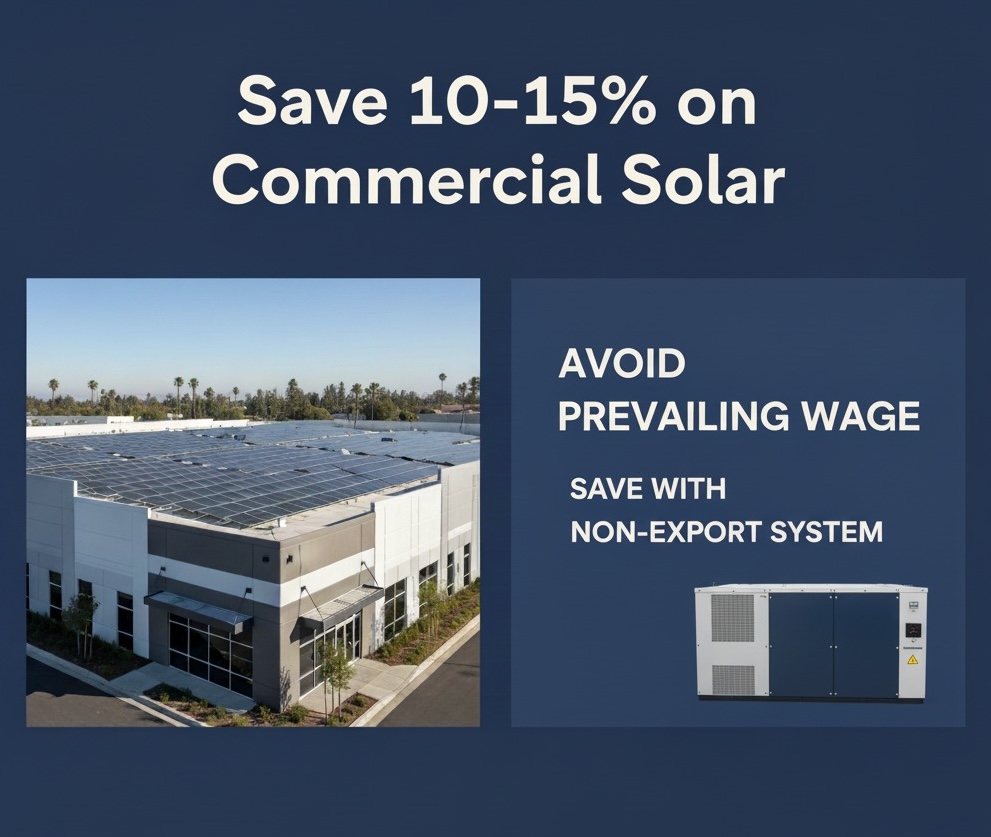
We covered how to avoid prevailing wage requirements in our guide to non-export solar systems - that’s a separate compliance issue from FEOC.
Bottom line: A commercial solar project may need to satisfy both FEOC equipment rules AND prevailing wage labor rules to maximize tax credits.
How to Verify Your Equipment Qualifies
Step 1: Request Supplier Certifications
Every manufacturer should provide written certification of FEOC compliance:
- Country of manufacture for all major components
- Ownership structure disclosure
- Supply chain documentation for cells, wafers, and critical minerals
Step 2: Research Manufacturer Ownership
Do your homework. No manufacturers are officially “FEOC-certified” by the IRS yet, but you can research:
- U.S. manufacturers with domestic supply chains tend to be safer bets
- Korean-owned manufacturers (like Qcells) may have cleaner supply chains than Chinese-owned competitors
- Thin-film technology manufacturers (like First Solar) often have supply chains that avoid Chinese components
Red flags: Any manufacturer with significant Chinese ownership, or vague answers about supply chain origins.
Step 3: Document Everything
Maintain a compliance file:
- Supplier certifications
- Bill of materials with country of origin
- Manufacturer ownership disclosures
- Third-party verification if available
Step 4: Work with Contractors Who Take This Seriously
Your installer should have a documented process for FEOC compliance. If they can’t explain how they verify equipment - or seem annoyed that you’re asking - that’s a red flag.
The Domestic Content Bonus: 40% Instead of 30%
If you go beyond basic FEOC compliance to meet full domestic content requirements, you can earn an additional 10 percentage points on your tax credit.
| Credit Type | Base ITC | With Domestic Content Bonus |
|---|---|---|
| Standard Commercial Solar | 30% | 40% |
What Domestic Content Requires
Steel and Iron: 100% U.S. manufactured
Manufactured Products:
- 40% domestic content for projects starting before 2025
- 55% domestic content for projects starting in 2026+
Is It Worth It?
For a $600,000 commercial solar installation:
- Base ITC (30%): $180,000
- With domestic content bonus (40%): $240,000
- Additional benefit: $60,000
The domestic content bonus requires more documentation and sometimes costs more for compliant equipment. But when the bonus is worth $40,000-$100,000 on a typical commercial project, the math often works.
Your contractor should run these numbers for your specific project.
Common Mistakes That Cost Businesses Their Tax Credits
Mistake 1: Assuming “Made in USA” Means Compliant
A panel assembled in the United States using Chinese cells is likely non-compliant. Assembly location isn’t the same as supply chain compliance.
Mistake 2: Taking Your Contractor’s Word Without Documentation
Get it in writing. A verbal assurance won’t help when your CPA needs to document the credit or if you’re audited.
Mistake 3: Only Checking the Panels
Inverters, batteries, and racking all have FEOC requirements. A compliant panel paired with a non-compliant inverter creates problems.
Mistake 4: Waiting Until Tax Filing to Verify
FEOC compliance must be established at equipment purchase. You can’t fix it after the system is installed.
Mistake 5: Confusing FEOC with Prevailing Wage
These are separate requirements. You may need to meet both to maximize your credit.
What This Means for Your California Project
If You’re Researching Solar
- Get equipment lists in writing before signing contracts
- Ask specifically about FEOC compliance for every component
- Request documentation, not verbal assurances
- Ask whether the domestic content bonus makes financial sense
If You’re Comparing Bids
FEOC compliance should be addressed in every commercial solar proposal. If it’s not mentioned, ask.
Red flags:
- Contractor can’t name specific equipment brands and models
- “We’ll handle the tax credit stuff” without documentation
- Significantly lower prices with vague equipment specs
- Reluctance to discuss manufacturer supply chains
Questions to Ask Your Contractor
- “Can you provide FEOC compliance documentation for all equipment?”
- “What is the country of origin for the solar cells - not just where panels are assembled?”
- “Does your equipment come from manufacturers with ownership ties to China, Russia, North Korea, or Iran?”
- “How do you verify supply chain compliance?”
- “Will you provide documentation for my CPA?”
How Keen Energy Handles FEOC Compliance
We’ve built FEOC verification into our standard process because we’ve seen California businesses get burned by contractors who don’t address this.
What we do:
-
Equipment selection: We specify components from manufacturers with verified supply chains and documented compliance
-
Written documentation: Every proposal includes specific equipment brands, models, and compliance certifications
-
Domestic content analysis: We run the numbers to show whether the 10% bonus makes sense for your project
-
Ongoing verification: Supply chains change. We verify compliance at equipment purchase, not just at proposal
-
CPA-ready documentation: We provide packages formatted for your tax advisor
Frequently Asked Questions
What happens if my equipment isn’t FEOC-compliant?
You lose eligibility for the Section 48E Investment Tax Credit. For most commercial projects, this means forfeiting 30% of your system cost - potentially $50,000 to $300,000+ depending on size.
Can I use Chinese panels and still get the tax credit?
Generally no, unless you established safe harbor before January 1, 2026. Projects starting in 2026+ must meet FEOC thresholds.
How much more does FEOC-compliant equipment cost?
Typically 5-15% more than non-compliant alternatives. However, this premium is far less than the 30% tax credit you’d lose.
Do FEOC rules apply to residential solar?
The Section 25D residential credit (homeowner-owned systems) currently doesn’t have FEOC restrictions. Third-party owned systems (leases and PPAs) under Section 48E do.
What about systems over 1 MW? Are there additional requirements?
Yes. Systems over 1 MW must meet prevailing wage and apprenticeship (PWA) requirements to get the full 30% base credit. Without PWA compliance, the credit drops to 6%. This is separate from FEOC compliance - you may need to meet both.
What if a contractor says they can “work around” FEOC requirements?
Be cautious. There’s no legitimate workaround - equipment is either compliant or it isn’t. Contractors who suggest otherwise don’t understand the regulations or are setting you up for a denied claim.
How do I verify a manufacturer is FEOC-compliant?
Request written certification of ownership structure, manufacturing locations, and supply chain documentation. Note that the IRS hasn’t released official compliance certifications, so verification relies on manufacturer disclosures and supply chain documentation.
The Bottom Line
FEOC compliance isn’t optional for commercial solar projects starting construction in 2026 and beyond. It’s the difference between receiving a 30% tax credit and getting nothing.
The good news: With proper planning and the right contractor, FEOC-compliant commercial solar is available. Many projects can also qualify for the domestic content bonus, bringing the total credit to 40%.
The risk: Contractors who don’t address FEOC upfront, equipment specs without country-of-origin details, and the assumption that “everyone gets the tax credit” regardless of equipment choices.
Before you sign any commercial solar contract, make sure FEOC compliance is explicitly addressed with documentation to back it up.
Ready to Talk About Your Project?
We include FEOC compliance documentation as a standard part of every commercial solar proposal.
Request a free consultation to review your project timeline, equipment options, and tax credit eligibility.
Contact Keen Energy | (949) 877-8008
Disclaimer: This article is for educational purposes only and does not constitute tax, legal, or financial advice. Tax credit eligibility depends on your specific circumstances, and regulations continue to evolve. Consult with a qualified tax professional or CPA before making decisions about your solar investment and tax credit claims.
Frequently Asked Questions
What happens if my equipment isn't FEOC-compliant?
You lose eligibility for the Section 48E Investment Tax Credit. For most commercial projects, this means forfeiting 30% of your system cost - potentially $50,000 to $300,000+ depending on size.
Can I use Chinese panels and still get the tax credit?
Generally no, unless you established safe harbor before January 1, 2026. Projects starting in 2026+ must meet FEOC thresholds.
How much more does FEOC-compliant equipment cost?
Typically 5-15% more than non-compliant alternatives. However, this premium is far less than the 30% tax credit you'd lose.
Do FEOC rules apply to residential solar?
The Section 25D residential credit (homeowner-owned systems) currently doesn't have FEOC restrictions. Third-party owned systems (leases and PPAs) under Section 48E do.
What about systems over 1 MW? Are there additional requirements?
Yes. Systems over 1 MW must meet prevailing wage and apprenticeship (PWA) requirements to get the full 30% base credit. Without PWA compliance, the credit drops to 6%. This is separate from FEOC compliance.
Tags
Ready to Start Your Solar Project?
Get expert guidance and a free solar assessment for your Southern California property.