Project Case Study: HOA / Multi-Unit Residential
Garage-mounted solar arrays, underground electrical work, and a VNEM interconnection: a commercial-scale solar project threaded through an occupied homeowners association community near the coast.
181.5kW
System Size
VNEM
Interconnection
Garage
Mounted Arrays
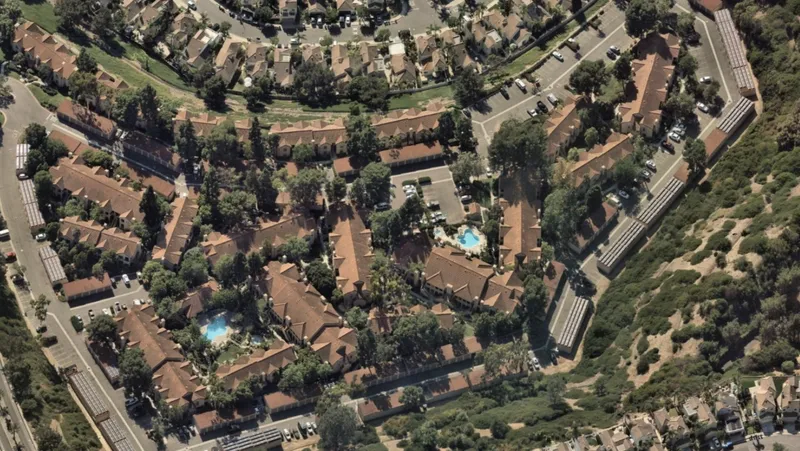
A homeowners association is not one building with one meter. It is many households, shared infrastructure, and a board accountable to all of them. A solar project here has to deliver value across multiple units, survive board-level scrutiny, and get built without turning the community into a construction site.
This San Clemente community had usable roof area in an unglamorous place: garage structures topped with hot tar gravel roofing. Getting power from those garages to where it counts meant underground electrical work, and sharing the output across the community meant a Virtual Net Energy Metering (VNEM) interconnection.
Keen delivered all of it as one scope: arrays, boring, electrical, and utility paperwork.
Full EPC delivery: engineering, procurement, construction, permitting, utility interconnection, and commissioning under one contract.
181.5kW of solar mounted on garage structures with hot tar gravel roofing, putting otherwise idle roof area to work for the community.
Underground boring and electrical work to route power through the site cleanly, without carving open trenches through the community's streets and landscaping.
A Virtual Net Energy Metering interconnection, so one shared system can allocate credit across the multi-unit community rather than serving a single meter.
Mounting on garage structures kept the work off residents' roofs entirely: no penetrations over living space, no coordination with individual homeowners' roofing warranties. Hot tar gravel roofing takes mounting expertise that most residential-oriented installers never develop.
Underground boring let crews route conductors beneath the community with far less surface disruption than open trenching. This is where being electricians first pays off. The same in-house C-10 capability behind our electrical services handled the boring, the conduit runs, and the interconnection.
VNEM is what turns one array into a community asset: generation credits from the shared system are allocated across units under the utility's tariff. It is paperwork-heavy and unforgiving of design mistakes, which is why the interconnection strategy was part of the engineering from day one, not an afterthought.
We do not publish client financials. Here is what published market data says about systems in this class, clearly labeled:
Illustrative estimate: not this client's actual costs or savings
HOA boards get our numbers with the assumptions shown. Clear numbers. No sales pressure.
If you sit on an HOA board or manage multi-unit residential property, this project shows that shared solar is buildable in an occupied community; that difficult roofing and awkward electrical routing are solvable engineering problems, not disqualifiers; and that VNEM can distribute the value of one well-placed system across many households.
Coastal communities also face conditions inland systems never see. Our guides to salt corrosion and marine layer production effects cover what coastal ownership actually involves, and our O&M services keep coastal systems performing. Keen serves coastal Orange County and North San Diego County, including Oceanside and Newport Beach.
No cost. No obligation. Just clear numbers your board can actually evaluate.
We've received your request and will be in touch within 24 hours.
Or call now: (949) 877-8008