Project Case Study: Multi-Family Housing
A rooftop system spread across three apartment buildings, interconnected under VNEM: commercial solar aimed squarely at the common-area electric costs that property owners carry every month.
139kW
System Size
3
Buildings
VNEM
Interconnection
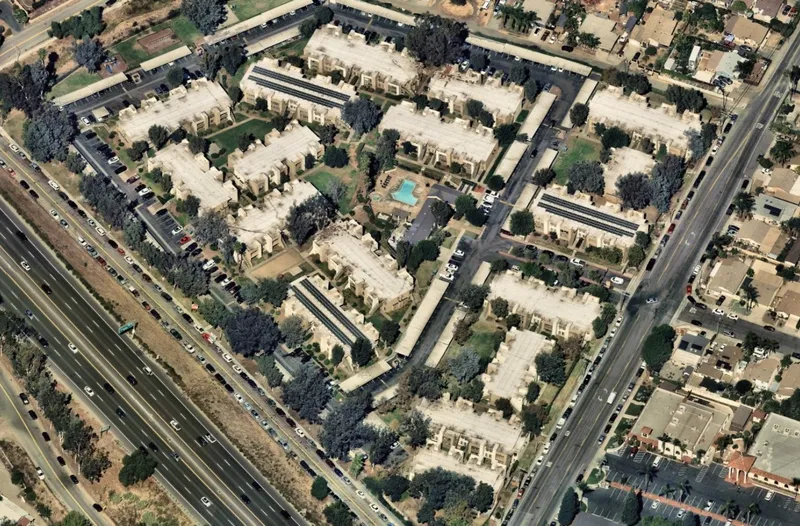
Tenants pay their own unit meters. What the owner pays for is everything shared: exterior and corridor lighting, laundry, irrigation, amenity spaces, month after month, on a bill that only moves one direction.
Those common-area costs are a direct hit to net operating income, and unlike a vacancy problem, they never lease themselves back up. Cutting them permanently is one of the cleaner NOI plays available to a multifamily owner.
This Vista complex had the roof area to do it. Keen designed a 139kW system across three buildings, using ballasted roof mounts and a VNEM interconnection to put the production where it benefits the property.
Full EPC delivery: engineering, procurement, construction, permitting, utility interconnection, and commissioning, with one contractor accountable for all of it.
139kW distributed across three apartment buildings, designed as one coherent system rather than three disconnected installs.
Ballasted mounting secures the arrays with engineered weight instead of roof penetrations, a fit for these flat roofs and the owner's roofing warranty.
Virtual Net Energy Metering allocates the system's generation credits under the utility tariff, built around the property's common-area savings goal.
Every mounting decision is a trade-off between roof type, structure, and wind exposure. Here, ballasted mounts were the right answer: no penetrations through the roof membrane, straightforward engineering on flat roofs, and clean removal whenever the roofs are eventually replaced. On our La Verne manufacturing project, the same analysis pointed the opposite direction, to a ballastless system. The roof decides, not the product catalog.
Distributing 139kW across three buildings meant coordinating array layouts, conductor routing, and interconnection as a single engineered system. Keen's in-house C-10 electrical crews, state-certified Journeymen and Apprentices, self-performed the electrical scope across all three buildings.
The interconnection was configured for the purpose the owner actually had: reducing common-area electrical expenses. Under NEM 3.0's reduced export compensation, how a multifamily system is structured matters more than it used to. Our NEM 3.0 guide explains why.
We do not publish client financials. Published market data for systems in this class looks like this, labeled as illustrative:
Illustrative estimate: not this client's actual costs or savings
The right answer depends on your buildings, your tariff, and your hold period. We show you the math, not marketing promises.
If you own or manage apartment properties, this project shows that multifamily solar does not require tenant participation to make sense (common-area load alone can justify a system); that multi-building sites can be engineered as one project with one interconnection strategy; and that mounting can be chosen to protect your roofing warranty rather than complicate it.
Keen Energy serves multifamily owners across North San Diego County, including Carlsbad, Oceanside, and Escondido. See what full-scope delivery looks like on our EPC contractor page.
No cost. No obligation. Just clear numbers on what solar can do for your NOI.
We've received your request and will be in touch within 24 hours.
Or call now: (949) 877-8008