Retail Centers, Storefronts & Car Lots
Retail runs on daylight hours: HVAC, lighting, and refrigeration all peak while the sun is up. That load shape is exactly what solar serves best. Keen Energy builds rooftop and carport commercial solar for shopping centers, standalone stores, and car lots across Southern California.
800MW+
Founder Experience
30+
Years Leadership
C-10
Licensed
A retail center is two solar sites in one: a flat roof over the stores and a parking field in front of them. Both can generate power, and under NEM 3.0 the value comes from consuming that power on site during operating hours, which is precisely when retail loads run.
Store hours and solar hours overlap almost completely. Air conditioning, sales-floor lighting, refrigeration cases, and point-of-sale systems draw hardest at midday, when the array produces most. That self-consumption is what preserves returns under NEM 3.0's reduced export compensation.
Demand charges can be 30-70% of a commercial electric bill, and retail HVAC on a summer afternoon is what sets them. Solar clips those daytime peaks. Optional battery storage can shave them further; we treat batteries as a financial decision, not just backup, and model both cases.
Carport solar turns parking into shaded, energy-generating space. Customers get covered parking; you get generation capacity without touching the roof. Turn your roof, parking lot, or unused land into a revenue-generating asset instead of a line item.
Commercial entities can claim the 30% federal solar tax credit through the end of 2027, and MACRS depreciation stacks on top of it. Well-designed California commercial systems typically pay back in 5-8 years. Those are typical ranges, not promises; your rate schedule and load profile set the real number.
Most retail projects end up as a mix. We size each surface for what it does best and design the electrical backbone once, so the system grows with the property.
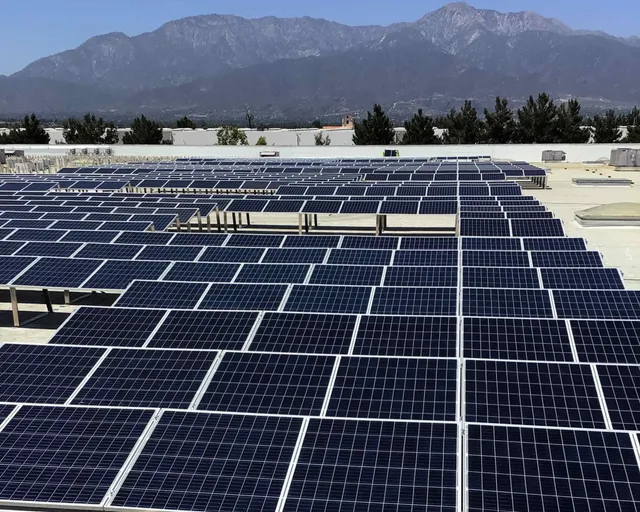
Strip centers and big-box stores carry wide, low-slope roofs that take ballasted racking with minimal structural impact. Rooftop is usually the lowest cost per watt on a retail property, and it stays out of sight from the parking field.
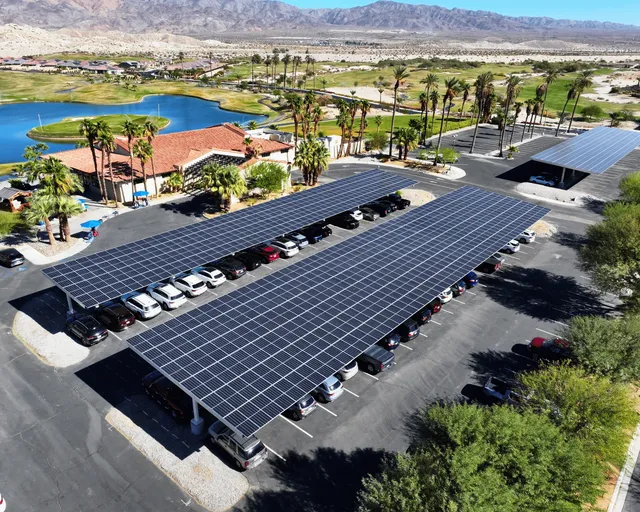
Carports cost more per watt than rooftop but add capacity the roof cannot hold, and the shade itself has customer value. For car lots, canopies do double duty: generation above, protected inventory below. Our take on dealership economics is in our solar for car dealerships article.
The Real Question in Retail Solar
In triple-net (NNN) retail, the landlord owns the roof while tenants pay the utility bills. That split kills more retail solar projects than any engineering problem, because the party who would invest is not the party who saves. There are workable structures for each situation, and we help you find the one that fits your leases.
The simple case: you own the building and pay the bill, so the savings and the tax benefits land in the same place. Direct purchase with the 30% ITC and MACRS usually delivers the strongest long-term return.
Landlords can serve house meters and common-area loads directly, and depending on lease structure, recover system costs or sell power benefits through the lease. It is lease-by-lease work; we model the meters and the leases before proposing a structure.
A solar PPA puts a third-party-owned system on the property with $0 upfront. You buy the power at a fixed escalator, typically 2-3% versus the 5-6% historical utility increases, and capital stays free for the core business.
Shoppers with EVs pick the center where they can charge. Because Keen Energy is a C-10 electrical contractor first, we install Level 2 and DC Fast charging as part of the same project: one design, one trench plan, one interconnection, one crew. Chargers add daytime load that soaks up solar production on site, which is exactly what you want under NEM 3.0. Panel and service upgrades, charger circuits, and the array all fall under our electrical services scope. Electricians First. Solar Second.
Carport solar plus Level 2 charging turns the parking field into an amenity that extends dwell time. Wiring both at once avoids trenching the same lot twice, and the shared electrical infrastructure is sized once, correctly.
EV inventory has to arrive charged and stay charged, which puts real load on a dealership's service. Solar canopies over inventory rows plus DC Fast charging in service lanes is a natural pairing, and one we design as a single electrical system.
Comparing verticals? See solar for warehouses and manufacturing solar, or start from the full solar panels for business guide. We build retail projects across Orange County and beyond, including Huntington Beach and Anaheim.
Roof, parking field, or both: we will model the system, the structure that fits your leases, and the numbers behind it. Clear numbers. No sales pressure.
Tell us about your center, store, or lot and we'll respond within 24 hours.
We've received your request and will be in touch within 24 hours.
Or call now: (949) 877-8008