California Commercial Solar Incentives: What Businesses Can Claim in 2026
The commercial solar incentives California businesses can actually claim in 2026: the federal ITC, MACRS depreciation, AB 2143 strategy, and how NEM 3.0 changes the math.
Search “California commercial solar incentives” and you’ll find pages listing a dozen programs: half expired, half residential-only, most padded to look generous. The real list for a California business in 2026 is shorter than that, and the items on it are worth more than the padding suggests.
Here’s what you can actually claim, what each one is worth, and where the traps are. As always: we show you the math, not marketing promises.
The 30% Federal ITC: Still the Biggest Lever
The federal Investment Tax Credit covers 30% of the total installed system cost for commercial solar: equipment, labor, engineering, permitting, all of it. It’s a credit, not a deduction: a direct reduction in federal tax owed.
Two rules determine how cleanly you get it:
Under 1 MW: the 30% applies without labor conditions. Most commercial rooftops in Southern California fall here, which keeps the claim straightforward.
Over 1 MW: prevailing wage and apprenticeship requirements apply to claim the full credit. That’s not a reason to avoid a large system. It’s a reason to make sure your contractor prices and staffs the project for compliance from day one, rather than discovering the requirement at tax time.
The window: commercial entities can claim solar tax credits through the end of 2027. That sounds distant until you run the project math backward: a commercial installation typically takes months from signature to permission to operate, and utility interconnection queues don’t move for tax deadlines. We break the full sequence down in our commercial solar installation timeline guide.
FEOC Requirements: The Compliance Gate on the Credit
FEOC (foreign entity of concern) requirements now apply to claiming the 30% commercial credit. In practice, they constrain where your panels, inverters, and related equipment can come from, and they turn equipment sourcing from a pure price decision into a compliance decision.
This is the trap in low bids right now. A proposal that undercuts the market on equipment cost may be specifying hardware that jeopardizes your credit, and the credit is worth far more than the discount. Ask every bidder to confirm FEOC compliance in writing. The full rules are in our FEOC requirements guide.
MACRS Depreciation: The Incentive Proposals Skip
Commercial solar qualifies for accelerated MACRS depreciation, a schedule that lets your business recover the system cost against taxable income far faster than the asset’s actual service life. Combined with the ITC, depreciation is a substantial second layer of value that many one-page proposals never model, because it requires knowing something about your tax situation.
The honest caveat: depreciation, like the credit, only has value against tax you actually owe. The exact benefit depends on your entity structure and income. Model it with your CPA, not with a sales sheet. But for a profitable business, it materially changes the net cost of the system.
AB 2143: The Incentive You Claim by Not Triggering It
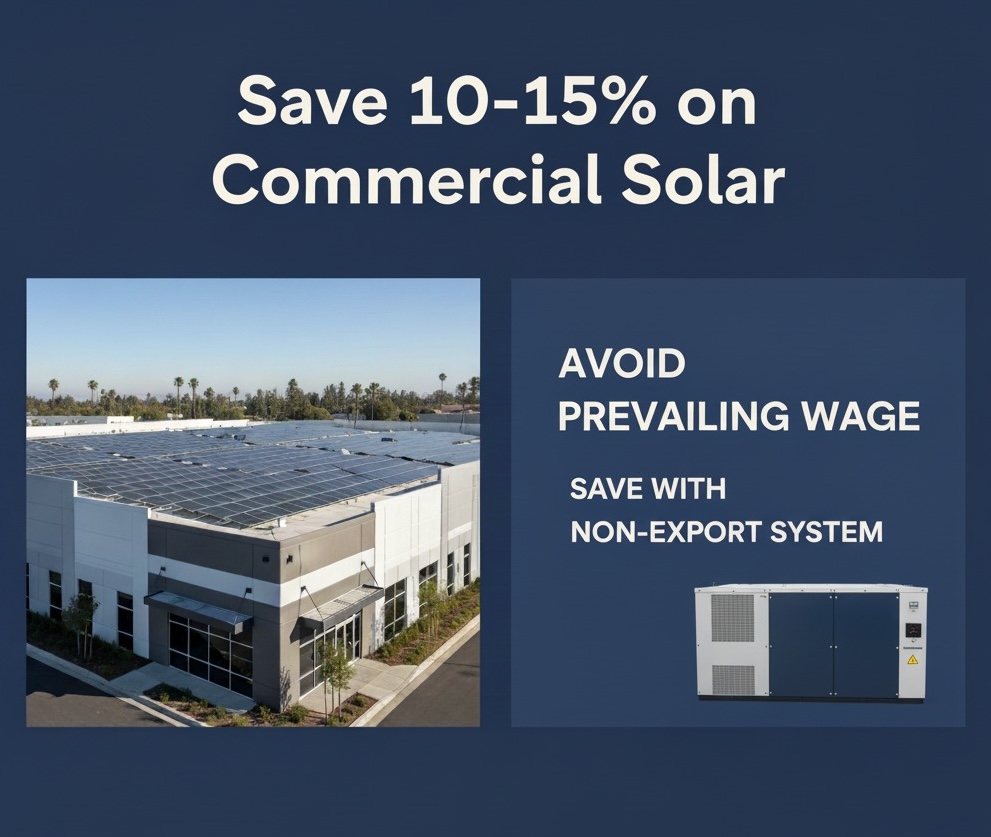
Not every lever is a credit. Under California’s AB 2143, certain project structures trigger prevailing wage requirements, and avoiding those triggers can save 10-15% on commercial solar costs. This is design-stage strategy: how the project is sized, structured, and contracted determines whether the requirement applies at all.
It’s also a good test of your contractor. An installer who can’t explain how AB 2143 applies to your specific project is guessing with your budget. The details are in our AB 2143 prevailing wage guide.
NEM 3.0: Not an Incentive — But It Sets the Math
California’s NEM 3.0 (the Net Billing Tariff) isn’t a program you claim; it’s the rulebook your savings live under. It reduced compensation for power exported to the grid, which changed how systems should be designed: on-site consumption during operating hours preserves returns; heavy export erodes them.
For most businesses this is manageable, because most businesses use power when the sun is up. It also strengthened the case for storage: batteries let you shift production to when it’s worth more and attack demand charges, which run 30-70% of commercial bills in Southern California. We treat batteries as a financial decision, not just backup, and they’re explicitly optional. The full picture is in our NEM 3.0 guide for California businesses.
What the Stack Looks Like in Practice
An illustrative example (typical ranges, not a quote and not a promised outcome):
Southern California commercial solar runs $2.20–$3.20 per watt installed before incentives, with sub-100kW systems at the higher end (full breakdown in our 2026 cost guide). Take 30% off through the ITC, layer in MACRS depreciation against a normal tax position, and offset utility rates in SCE or SDG&E territory, and well-designed systems typically reach payback in 5–8 years. Businesses with high daytime consumption and heavy demand charges land at the shorter end of that range; that’s true whether your facility is in Corona, Irvine, or the Coachella Valley.
After payback, the system keeps producing on Tier-1 equipment carrying 25-year manufacturer warranties, with the energy cost line effectively fixed while utility rates keep climbing.
One number worth flagging from the other direction: industry ROI estimates often miss by 20-30% because they use generic assumptions. Any incentive stack modeled on template numbers instead of your interval data and your rate schedule should be treated as marketing, not math.
No Tax Appetite? The PPA Route
Nonprofits, schools, pre-profit companies, and businesses without meaningful federal tax liability can’t use credits directly, but they don’t have to leave the value on the table. Under a solar PPA, a provider owns the system, monetizes the ITC and depreciation, and sells you the power at $0 upfront with a fixed escalator, typically 2-3% versus the 5-6% historical utility increases. You trade ownership economics for zero capital outlay and immediate savings.
Whether owning or a PPA wins for your situation depends on your tax position and your cost of capital. We’ve written a full PPA vs purchase comparison on exactly that trade.
How to Vet Incentive Claims in a Proposal
Before you sign anything, make every bidder answer four questions:
- What’s the ITC basis? The 30% should apply to the documented installed cost. Get the line items.
- Is the equipment FEOC-compliant? In writing.
- What’s the prevailing wage assumption? Especially near the 1 MW threshold, and for AB 2143 exposure at any size.
- Is the savings model built from my interval data? If the answer involves the word “typical,” you’re looking at a template.
A proposal that survives those four questions is worth comparing. One that doesn’t isn’t a low bid. It’s an incomplete one.
Where This Leaves a California Business in 2026
The incentive stack is real: 30% off the top federally, accelerated depreciation behind it, a design-stage strategy that can hold costs down, and a financing route for organizations that can’t use the credits. The window through end of 2027 is also real, and the project timeline eats into it more than most owners expect.
If you’re starting from zero, our solar panels for business overview covers the system decisions that come before the incentive math. When you’re ready to see the numbers on your actual building, that’s what our commercial solar team does: clear numbers, no sales pressure.
Want the Incentive Math on Your Building?
We’ll model the ITC, depreciation, and rate offset from your utility data, not a template, and show you exactly what your business can claim. No cost. No obligation. Just clear numbers on what solar can do for your business.
Schedule a consultation or call us at (949) 877-8008.
Incentive values depend on your entity structure, tax position, and project specifics. Model final numbers with a qualified CPA or tax advisor. Cost and payback figures reflect typical Southern California commercial installations as of 2026 and are illustrative, not guaranteed outcomes.
Related reading:
Related Resources
Our Services
Service Areas
Frequently Asked Questions
What is the federal solar tax credit for businesses in 2026?
The federal Investment Tax Credit (ITC) covers 30% of the total installed cost of a commercial solar system. For systems under 1 MW, the 30% applies without labor conditions. Systems over 1 MW must meet prevailing wage and apprenticeship requirements to claim the full credit.
How long can businesses claim the commercial solar tax credit?
Commercial entities can claim solar tax credits through the end of 2027. Because a commercial project typically takes months from signed agreement to permission to operate, businesses planning around that window need to start well before it closes.
What are FEOC requirements and do they affect my tax credit?
FEOC (foreign entity of concern) requirements apply to claiming the 30% commercial solar credit. They constrain where system equipment can be sourced. A system built with non-compliant equipment can put the credit at risk, so equipment sourcing is now a compliance question, not just a price question.
What if my business doesn't have enough tax liability to use the credit?
Tax credits and depreciation only have value against tax you owe. Businesses without enough tax liability can carry credits forward or use a solar PPA: a provider owns the system, monetizes the incentives, and sells you the power at $0 upfront with a fixed escalator, typically 2-3% versus 5-6% utility increases.
Is commercial solar still worth it in California under NEM 3.0?
Yes, with the right design. NEM 3.0 reduced compensation for exported power, so systems sized for on-site consumption during operating hours preserve their returns, while systems sized to export do not. Battery storage has also become more compelling under NEM 3.0 for shifting production and managing demand charges.
Tags
Get the incentive math for your facility
Get expert guidance and a free solar assessment for your Southern California property.